| World premiere Comédie musicale in three acts by Sacha Guitry
Music by Reynaldo Hahn Conductor Jean Luc Tingaud
Direction, Staging, and Costumes Pier Luigi Pizzi
Choreography Gheorghe Iancu Orchestra J. Futura
Mozart Sophie Haudebourg
Barone Grimm Jean Sorel
Marquis de Chambreuil Adrien Melin
Vestris Gheorghe Jancu
Grimaud Alexandre Marcelli
Madame d’Epinay Marie-Thérèse Keller
La Guimard Orianne Moretti
Mlle Marie-Anne de Saint-Pons Blanche Eluel
Louise Olivia Doray
A new production of the
Spoleto52 Festival dei 2Mondi
Mozart will be presented in French with Italian subtitles. The comédie musicale Mozart was first presented in 1925 at the Edouard VII Theater, as a result of an encounter between the playwright and actor Sacha Guitry and the composer Reynaldo Hahn. Guitry wrote the musical as a showcase for his wife, the famous actress and took the show on tour in the United States, with her in the main role of Mozart, while he himself played the role of Baron Grimm. Guitry was inspired by the resemblance between the Parisian “salons” at the beginning of the twentieth century—where Guitry and Hahn were sought-after social favorites—and those frequented by the young Mozart during his second period in Paris, at a time when the French aristocracy had acclaimed him as a child prodigy years but failed to recognize his genius. The plot evolves in the salons of Baron Grimm, Mozart’s patron, where the young genius, finally free of strict paternal control, attracts the interest of ladies of all ages and social classes to become the central character in a series of frivolous and amusing amorous adventures. “We have Mozart, but not his music, there is marivauxdage but without Marivaux, we are in the “century of light” but with different lighting. So basically what do we have? An irreverent game, an erudite and elegant pastiche created through the caustic genius of Sacha Guitry with the refined and ironic complicity of Reynaldo Hahn. The events take place in a Parisian Salon during the 1920s. The Salon is frequented by Marcel Proust and aspects of “the search for lost time” can be rediscovered in certain characters and events from the past transported into a contemporary setting that seems totally natural.”
Pier Luigi Pizzi | Sacha Guitry was a French actor, playwright-director, and screenwriter born in Saint Petersburg in 1885. He wrote more than 120 plays, also performing in a large number personally. A celebrity in Parisian society, he was married to the actress and singer Yvonne Printemps. His film career also brought him fame both as an actor and as a director, although his main renown is linked with the very popular drawing room comedies of the period called comédies de boulevard. He died in Paris in 1957.
Reynaldo Hahn was a French composer, conductor, writer, and music critic. He was born in Caracas in 1875, and moved to Paris with his family at the age of three. He was a child prodigy, studying at the Paris conservatory under Jules Massenet. He was famous for his operas, and was a very close friend of Marcel Proust. He wrote operas, operettas, musical comedies, and orchestral, chamber, and stage music. During his career he conducted stage works by Mozart, including at the famous Salzburg festival. For many years he was the music critic for the French newspaper Le Figaro. After the Second World War in 1945, he was appointed Director of the Paris Opera. He died in Paris in 1947.
Pier Luigi Pizzi is an internationally famous director as well as a stage and costume designer. He was born in Milan and studied architecture at the Politecnico University, as well as theater with Giorgio Strehler. For twenty-five years he worked with Giorgio De Lullo and the “Compagnia dei Giovani,” creating some of his most famous work. His very long theatrical career includes at least 500 performances. He began his career in 1987 at the Wortham Center in Houston with Verdi’s Aida, and in 1990 with Les Troyens by Berlioz at the Opéra de la Bastille, and spent ten years working in many of the best theatres in Paris. In 2005 he participated in the re-opening of the La Scala Opera House with Europe Recognised by Salieri. For forty years his name has been linked with that of La Scala for memorable works like Armide by Gluck, through to his recent Merry Widow by Lehár. The inauguration of the Teatro delle Muse in Ancona was celebrated with his Idomeneo by Mozart, and in the same theater he also produced Elegy for Young Lovers by Henze and News of the Day by Hindemith. He also collaborated with the Teatro Real of Madrid where he opened the 2005 season with Verdi’s Traviata, and where he is currently producing Monteverdi’s “Venetian Trilogy.” He has been part of the Rossini Opera Festival for over 30 years, participating in the important rediscovery of Rossini’s works. For many years he has worked with the Teatro La Fenice in Venice where he created famous productions such as The Passion According to St. John by Bach, and more recently Thaïs by Massenet, Death in Venice by Britten, and The Dead City by Korngold.
Because of his successful career at the Montecarlo Opéra he was awarded the title of Commander of the Order of Cultural Merit. This is in addition to a long list of past awards: Order of Merit of the Italian Republic (Grand Officer), Officer of the Legion of Honor and Officer of the Order of Arts and Letters in France, the Rubinstein prize “Una vita nella musica,” honorary citizenship of Bibbiena, the keys to the city of Venice, an honorary degree from the University of Macerata, and at least eight awards presented by the Italian National Association of Music Critics. His recent return to prose theater with Goldoni’s One of the Last Evenings of Carnival was greeted with great enthusiasm, also winning him the Olimpico award and the Critics award for the best production of the year.
Since 2006 he has been the artistic director of the Sferisterio Opera Festival in Macerata.
He returns to Spoleto following his production of D´amore si muore by Giuseppe Patroni Giffi performed during the inaugural year of the festival, and his remarkable The Imaginary Invalid by Molière, played by the unforgettable Romolo Valli.
Jean-Luc Tingaud studying the piano and conducting at the Paris National Conservatoire, Jean-Luc Tingaud was chosen by Manuel Rosenthal to be his assistant. Rosenthal, himself a pupil of Maurice Ravel, was a formative influence, instilling in the younger man his passion for French music. In 1997 he founded OstinatO, a Paris based chamber orchestra composed of young graduates. They have performed in many different venues throughout France, including the Opéra Comique in Paris, the Opéra de Bordeaux, the Opéra de Nice, the Théâtre Impérial de Compiègne and many of the most prestigious French festivals. They were also invited by the Théâtre des Champs-Elysées to give a series of young people’s concerts, and since 2007 have been orchestrainresidence for the concert series at the Bibliothèque nationale de France. Opera has always been one of Jean-Luc Tingaud’s main interests. He has conducted Fauré’s Pénélope, Massenet’s Sapho and Auber’s Manon Lescaut at the Wexford Festival, Hahn’s Ciboulette for Opera Zuid, Offenbach’s L’île de Tulipatan at the Opéra National de Lyon, Le nozze di Figaro at the Théâtre Mogador in Paris, and La voix humaine and La Périchole in Compiègne. Recent engagements have included Mireille, L’elisir d’amore, La bohème, Così fan tutte and Carmen at the Théâtre d’Herblay in Paris, Berlioz’s Roméo et Juliette at the Teatro Nacional de Sao Carlos in Lisbon, Tosca in Besançon, Werther at the Festival della Valle d’Itria in Martina Franca, Dialogues des carmélites in Saint-Etienne, Riders to the Sea in Reims, Véronique in Metz and Pelléas et Mélisande at the Opéra de Toulon.His discography includes Sapho recorded at Wexford (Fonè), Werther recorded at Martina Franca (Dynamic), La Périchole and Adam’s Le toréador recorded at Compiègne (Mandala/Harmonia Mundi), Les trésors cachés de l’opéra français, a recording of French opera arias with the soprano Anne-Sophie Schmidt and the Budapest Opera Orchestra (Mandala/Harmonia Mundi), and the first recording of Manuel Rosenthal’s orchestral songs Chansons du Monsieur Bleu with the tenor Jean-Paul Fouchécourt (Sisyphe/Abeille Musique).From 2002 – 2007 Jean-Luc Tingaud was Associate Conductor of the Opéra Comique where recent projects have included Donizetti’s Rita, Adam’s Le toréador, Saint-Saëns’s La princesse jaune, Boieldieu’s Le calife de Bagdad, Offenbach’s Les bavards, Poulenc’s Les mamelles de Tirésias and Ibert’s Angélique. In 2004 he made his London debut at the Barbican conducting the English Chamber Orchestra with soloists Joshua Bell and Steven Isserlis. Other orchestras he has conducted in the UK include the Ulster Orchestra and the Orchestra of Opera North. Engagements this season include concerts with the Krakow Philharmonic (including Stravinsky The Rite of Spring), the Orchestra Filarmonica Arturo Toscanini, the Orchestra of the Opéra d’Avignon, Ulster Orchestra for the BBC Summer Series, the Lecce Orchestra and Carmen at the Opéra de Toulon. Since 2006 he has been Associate Conductor of the Grand Théâtre de Reims where this season he will conduct La Damnation de Faust.
Jean Sorel was born in Marseilles, but left in 1944 just before the German occupation. He moved to Paris where he began to study for a diplomatic career at the Ecole Normale Superieure. Purely by accident he replaced a friend who was a theatrical actor, and his passion for the theater made him abandon his university studies. His film debut occurred in 1959 with a supporting role in the film I Spit on Your Graves by Michel Gast, and fame arrived only a year later with Jacques Bourdon’s Young Lions. During the course of his brilliant career he has worked with famous directors like Luis Buñuel (Belle du Jour), Sidney Lumet (A View from the Bridge), Roger Vadim (Circle of Love), Luchino Visconti (Dim Stars of the Big Bear), Dino Risi (Play-Boy Party), Alberto Lattuada (L’Amica), and many others. He has also performed in live theater in Alice par d’obscurs chemins, and in 2001 in Candido, ovvero… by Leonardo Sciascia. Sophie Haudebourg began her musical education by studying the violin before deciding to dedicate herself to singing at the age of 16. After selection as a finalist in the competition “Voix Nouvelles” in 1998, she joined the Opéra Nationale de Lyon, where she performed in several productions: The Child and the Enchantments by Albert Herring, The Rape of Lucrece, The Magic Flute by Mozart in the role of Papagena, and The Cunning Little Vixen (Chocholka), a role she later performed again at the Théâtre des Champs Elysées. She began her career with her performances of Sophie in Werther, Zerlina in Don Giovanni, and Susanna in The Marriage of Figaro, followed by Musetta in La Bohème.
In recent years she has worked both in France and abroad; singing Jenufa (Jano) at the Opéra Royal de Wallonie, Javotte in Manon at the Opéra d’Avignon, La Périchole at the Opéra Comique, Elle in L’Amour Masqué at the Edinborough Festival, Pauline in La Vie Parisienne at the Opéra de Bordeaux, and Nadia in The Merry Widow at the Opéra Royal de Wallonie and at the Opéra Comique.
In April 2009 the Opéra de Nice selected Sophie Haudebourg for the role of Amore, god of love, in Gluck’s Orfeus.
Orianne Moretti is originally from Corsica, but studied at the Ballet National de Marseille established by Roland Petit before beginning her training as an opera singer at the Conservatoire de Région de Marseille. She continued at the Conservatoire National Supérieur de Musique in Paris under the guidance of Mireille Alcantara. She took acting lessons with Marianne Epin of the Comédie Française and with Anne Denieul. Her background training in opera, ballet, and theater have made Moretti an artist of great versatility: She sings German and Russian lieders, oratorios(Bach, Mozart, Gounod, and Fauré), and chansons (Debussy, Poulenc, and Saint Saëns). She has appeared in films (playing in certain scenes taken from the opera Ivan the terrible included in the film Tiger Brigades by Jérôme Cornuau), and stage musicals (she played Parthenis in Offenbach’s Beautiful Helena at the Capitole Theater in Toulouse and Ninetta in his La Périchole).
For the Festival Les Rencontres Musicales de Calenzana in Corsica in August 2008, she created a recital entitled A Travers Clara... in which she interpreted Clara Schumann with readings of Schumann’s personal letters interspersed with lieders, accompanied by the pianist Philippe Guilhon-Herbert. The recital was repeated again in Paris at the Théâtre de l’Archipel in the autumn of 2008. Moretti is also a choreographer and created the ballet The Confession (Weber) with a pas de deux by stars from the Opéra de Paris and the Leipzig Opera (2006).
Marie-Thérèse Keller received the first Prize for Singing, Lyrical Art and Baroque Chamber Music at the Conservatoire de Strasbourg, then entered the Paris Opera School, where she studied with Denise Dupleix and Hans Hotter.
During this period, she performed many roles at the Opera Garnier, The Opera Comique and the Opera Bastille, and elsewhere in France and abroad.
She held particularly distinguished roles such as Conception (Ravel’s L’heure Espagnole), Cherubino (Le Nozze di Figaro) Dorabella (Cosi fan Tutte), Lucretia (Britten’s Rape of Lucretia), Geneviève (Pelleas et Mélisande), The Baronessa (Il Capello di Paglia d’Italia), directed by Pier Luigi Pizzi in Nice, and the title role of Carmen at the Baalbeck Festival.
She has sung under the direction of Michel Plasson,Marek Janowski, Alain Lombard, Paul Ethuin, Simon Rattle...
She has also sung several times with Natalie Dessay and Rollando Villazon at Opera Bastille.
Marie-Thérèse Keller performs numerous recitals of Lieder and Mélodies, as well as Concerts and Oratorios.
In September she will participate in the recording of an Opera from Déodat de Séverac with the Luxembourg Philharmonic, and next season she will sing the role of Mère Marie in the Dialogues des Carmélites in Tours, Jenufa in Bordeaux, and Gianni Schicchi, Suor Angelica, The Bartered Bride and Lulu at Opera Bastille.
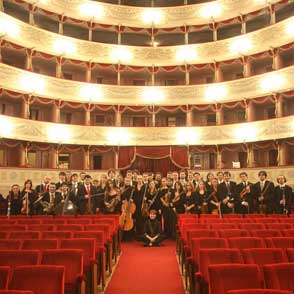
J. Futura Orchestra
The Orchestra was established in 2006 by Paola Stelzer, a well-known business-woman from Trento, and Maurizio Dini Ciacci, who became the artistic director. It is composed of young musicians between the ages of 18 and 30 who perform an unusual repertoire. Their great stylistic versatility is clearly visible in such recent works as Francis Poulenc’s The Human Voice at the Teatro Donizetti in Bergamo and the Teatro Malibran in Venice (a collaboration with the Teatro la Fenice Foundation); a series of concerts in Austria; and participation in important festivals and concert performances (Verona, Barga, Bertinoro, the Philharmonic Academy of Rome, the Mozart Festival in Rovereto, the Festival de Wallonie, and also two prestigious performances before the European Parliament and the European Council in Brussels). The orchestra has collaborated with the Scuola di Alto Perfezionamento Pianistico of Imola to perform a series of concerts for young soloists of considerable talent.
In 2009 the Orchestra will appear at the Biennale in Venice and during the summer, under the name of J. Futura International, it will participate in an orchestral group composed of musicians from Italy, Portugal, and France and directed at inaugurating a network of relationships with artists from throughout the European Community. Between November 2009 and April 2010 the Orchestra will be involved in a Mozart project in Rome in collaboration with the Philharmonic Academy. All the Orchestra’s projects are preceded by a preparatory period under the direction of qualified teachers in each musical section. Maurizio Dini Ciacci’s career in Italy and abroad has allowed him to bring a wealth of experience as a performing musician to his role as artistic director of the Orchestra.
|