| Tickets:
Stalls/Ground Circle€33
I/II/III Circles €23
Upper Circle €14 Program
Scuola di Musica di Fiesole Performances by the
Fiesole School of Music Tuesday, June 30
Sax quartet by Alda Dalle Lucche and Arabesque Quartet
Recital “Astor Dedicato”
Three tango sensations
Asleep
Loving
Fear Close your eyes and listen
Adios nonino
Oblivion
Reminescencia
Anos de soledad
Solitude
Summit
Wednesday, July 1st
Jaram Kim, violin
Angelo Arciglione, piano J.S. Bach, Sonata n.1 in G minor BWV 1001 for violin solo
Adagio
Fuga (Allegro)
Siciliano
Presto Ysaye, Sonata n. 6 in E major for violin solo Allegro giusto non troppo vivo
Allegretto poco scherzando L. v. Beethoven, Sonata Thursday, July 2
Oberon Quartet
Jaram Kim, first violin
Antonio De Sarlo, second violin
Federico Binet, viola
Pietro Horvath, cello F. J. Haydn, String quartet in B flat major op.76 n. 4 “L’Aurora” Allegro con spirito
Adagio
Menuetto. Allegro
Finale. Allegro ma non troppo
L. van Beethoven, String quartet in F major op. 18 n. 1
Allegro con brio
Adagio affettuoso ed appassionato
Scherzo. Allegro molto
Allegro Friday, July 3
Mitja Quartet
Giorgiana Strazzullo, first violin
Sergio Martinoli, second violin
Mariateresa Pagano, viola
Andrea D´Angelo, cello F. Mendelssohn, String quartet in A minor op.13 Adagio-Allegro vivace
Adagio non lento
Intermezzo
Presto A. Bazzini, Quartet in D minor op.75 n.2 Allegro appassionato
Andante con moto
Gavotte, Allegretto
Quasi presto
Saturday, July 4
Indaco Quartet
Eleonora Matsuno, violin
Jamiang Santi, violin
Andrei Harabagiu, viola
Naomi Berrill, cello
F. Schubert, String quartet movement in C minor D 703 “Quartettsatz" Allegro assai
Andante
L. van Beethoven, String quartet in F major op. 59 n.1 Allegro
Allegretto vivace e sempre scherzando
Adagio molto
Allegro
Sunday, July 5
Endymion Quartet
Clarice Binet, first violin
Fanny Ravier, second violin
Marco Nirta, viola
Luigi Gatti, cello
Beethoven, String quartet in B flat major op.18 n.6 Allegro con brio
Adagio, ma non troppo
Scherzo. Allegro
Adagio "La Malinconia"
Allegretto quasi Allegro
D. Sostakovich, String quartet n. 8 in C minor op.110
Largo
Allegro molto
Allegretto
Largo
Largo
Sunday, July 6
Orchestra J. Futura Director Maurizio Dini Ciacci
W. A. Mozart Serenata K.219 per due piccole orchestre in Re maggiore
B. Britten Sinfonietta op. 1
D. Milhaud La Création du Monde
P. Hindemith Kammeremusik, n. 1
Tuesday, July 7
Eleonore Darmon
Eliane Reyes, piano Debussy, Sonata Chausson, Poème in E flat major op. 25 for violin and piano Lento e misterioso M. Ravel, Tzigane: rapsody from concert for violin and piano Lento, quasi cadenza
F. Waxman, Carmen-fantasy for violin and piano
Wednesday, July 8
Angelo Arciglione, piano
L. van Beethoven: Sonata n. 32 in C minor op. 111 Maestoso
Allegro con brio e appassionato
Arietta. Adagio molto, semplice e cantabile
R. Schumann: Kreisleriana op. 16
Agitatissimo
Con molta espressione, non troppo presto
Molto agitato
Lento assai
Vivace assai
Lento assai
Molto presto Vivace e scherzando F. Chopin: Polacca-Fantasia in A flat major op. 61 Allegro maestoso Thursday, July 9
Fabrizio Falasca, violin
Pietro Gatto, piano L.van Beethoven, Sonata n.1 op.12 in D major for violin and piano Allegro con brio
Tema con variazioni. Andante con moto
Rondò. Allegro
C. Franck , Sonata in A major for violin and piano Allegro ben moderato
Allegro
Recitativo fantasia. Ben moderato
Allegro poco mosso H.Wieniawski, Polonaise brillante n.2 in A major op.21 for violin and piano N.Paganini, Cantabile in D major for violin and piano P. De Sarasate, Aria zingaresca op.20 n.1 for violin and piano Friday, July 10
Edoardo Turbil, piano Haydn, Sonata in C minor Hob. XVI:20 Moderato
Andante con moto
Finale. Allegro
Beethoven, Sonata n. 21 in C major Op. 53 ´Waldstein´ detta l’Aurora
Allegro con brio
Introduzione. Molto adagio
Rondo. Allegro moderato
Chopin, Sonata in B minor op. 58
Allegro maestoso
Scherzo. Molto vivace
Largo
Finale. Presto, ma non tanto
Saturday, July 11
Felix Duo
Vlad Maistorovici, Violin
Dario Bonuccelli, Piano
L. van Beethoven, Sonata n. 4 in A minor op. 23 for violin and piano Presto
Andante scherzoso, più Allegretto
Allegro molto F. Mendelssohn Bartholdy, Sonata in F major for violin and piano Allegro vivace
Adagio
Assai vivace
Sunday, July 12
Alberto Casadei, cello
Federico Colli, piano
R. Schumann, Fantasiestucke op.73 for cello and piano Zart und mit Ausdruck
Lebhaft, leicht
Rasch und mit Feuer
S. Rachmaninov, Sonata in G minor op.19 for cello and piano
Lento – Allegro moderato
Allegro scherzando
Andante
Allegro mosso
P. Tchaikovsky, Variations on a Rococo theme op.33 for cello and piano
Moderato quasi Andante
Tema. Moderato semplice
Var.1: Tempo del tema
Var.2: Tempo del tema
Var.3: Andante sostenuto
Var.4: Andante grazioso
Var.5: Allegro moderato
Var.6: Andante
Var.7: Allegro vivo e Coda | The Fiesole School of Music is pleased to participate, for the first time in its thirty-five years of existence, in one of Italy’s most important arts festivals. When Gian Carlo Menotti was at the helm of the Spoleto Festival, he extended an invitation to the Italian Youth Orchestra that could not be accepted solely for reasons of timing. Today we once again open the dialogue between a grand festival and an institution dedicated to musical education in order to make way for young concert performers and to offer them this unquestionably prestigious springboard. The musicians who will participate in the Noontime Concerts are students in the Master Classes of Pavel Vernikov, Natalia Gutman, Maria Tipo, Bruno Canino, and the Trio di Parma. They represent only a cross-section of the beehive of activity that characterizes the Fiesole School of Music, Piero Farulli’s Utopian dream. In thirty-five years, the School has grown from its embryonic beginnings as an institution open largely to amateurs in order to become what it is today: a representation of the highest levels of the concert profession. (Adriana Verchiani) Fiesole School of Music
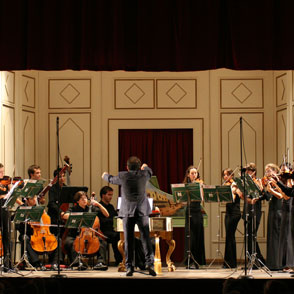
The Fiesole School of Music was established in 1974 by Piero Farulli and a group of musicians and music lovers as a private institution dedicated to filling the many gaps that existed in Italian musical life. The School is open to all, from children to adults and from amateur musicians to those who intend to make music their profession. The students (approximately 1300) are directed at an early age toward ensemble music. Beginning at age six they enter the “I Piccoli Musici” group (Little Musicians). Later, they continue in the Children’s Orchestra, the Galilei Orchestra and, finally, the Italian Youth Orchestra, which has been honored by the presence of such musical directors as Claudio Abbado, Ferro Muti, Giuseppe Sinopoli, Carlo Maria Giulini, and Jeffrey Tate (non si parla mai dei direttori della Giovanile). In addition to its basic curriculum, the School offers annual specialization courses with such instructors as M. Tipo, N. Gutman, P. Vernikov, B. Canino, G. Corti, M. Postinghel, C. Desderi, and the Trio di Parma. In 2002, together with a network composed of some of Europe’s most important institutions of musical education—from Vienna to Zurich, from Paris to Helsinki—the School established the European Academy for the Quartet. In addition to its four distinguished founders, Piero Farulli, Hatto Beyerle, Norbert Brainin, and Milan Škampa, the School’s instructors have included such illustrious musicians as G. Kurtág, V. Berlinsky, S. Sciarrino, A. Corghi, C. Coin, M. Stroppa, and F. Vacchi. The School’s activities are made possible by the financial support of the Ministry of Cultural Heritage and Activities, the Region of Tuscany, the City and the Province of Florence, and the City of Fiesole. Florence’s Cassa di Risparmio has been an irreplaceable patron in all the School’s initiatives. In 1981, the School received one of the first Abbiati Prizes for best initiative in the area of music education. On the basis of a nomination by the Accademia Nazionale di Santa Cecilia, Carlo Azeglio Ciampi awarded the School the National “President of the Republic” Prize in 2005. The Italian Youth Orchestra received the Abbiati Prize once again in 2004 and, in 2008, was awarded the Praemium Imperiale Grant for Young Artists. Andrea Lucchesini is currently the Artistic Director of the Fiesole School of Music. J. Futura Orchestra
The Orchestra was established in 2006 by Paola Stelzer, a well-known business-woman from Trento, and Maurizio Dini Ciacci, who became the artistic director. It is composed of young musicians between the ages of 18 and 30 who perform an unusual repertoire. Their great stylistic versatility is clearly visible in such recent works as Francis Poulenc’s The Human Voice at the Teatro Donizetti in Bergamo and the Teatro Malibran in Venice (a collaboration with the Teatro la Fenice Foundation); a series of concerts in Austria; and participation in important festivals and concert performances (Verona, Barga, Bertinoro, the Philharmonic Academy of Rome, the Mozart Festival in Rovereto, the Festival de Wallonie, and also two prestigious performances before the European Parliament and the European Council in Brussels). The orchestra has collaborated with the Scuola di Alto Perfezionamento Pianistico of Imola to perform a series of concerts for young soloists of considerable talent. In 2009 the Orchestra will appear at the Biennale in Venice and during the summer, under the name of J. Futura International, it will participate in an orchestral group composed of musicians from Italy, Portugal, and France and directed at inaugurating a network of relationships with artists from throughout the European Community. Between November 2009 and April 2010 the Orchestra will be involved in a Mozart project in Rome in collaboration with the Philharmonic Academy. All the Orchestra’s projects are preceded by a preparatory period under the direction of qualified teachers in each musical section. Maurizio Dini Ciacci’s career in Italy and abroad has allowed him to bring a wealth of experience as a performing musician to his role as artistic director of the Orchestra.
|