| ACCADEMIA PERDUTA
ROMAGNA TEATRI
Teatro Stabile d’Arte Contemporanea The Accademia Perduta/Romagna Teatri, today Teatro Stabile d’Arte Contemporanea (Repertory Theater of Contemporary Art) and directed by Ruggero Sintoni and Claudio Casadio, is recognized as one of most successful theater projects in Italy, France, Spain, Switzerland, and Portugal. The Teatro Stabile was established by a group of young actors in 1982 as the Children’s Theater Company. From its founding to the present, the Accademia Perduta has been engaged in the intensive and fruitful production of theatrical programming for children. The theater’s productions, written, directed, and often performed by Claudio Casadio, are distinguished by the precise and original style that has, over time, become their signature. The children’s theater produced by the Accademia Perduta Children’s Theatre transcends the “category” in order to become a true art form based in such fundamental considerations as attention to fantasy, dreamlike and evocative imagery, and the importance of involving spectators emotionally. The Accademia Perduta Children’s Theatre makes children dream, but it also knows how to take adults back to the dreams of their childhood. | Age range: 5-10 years By Marcello Chiarenza
Directed by Gianni Bissaca
Original music by Beppe Turletti With
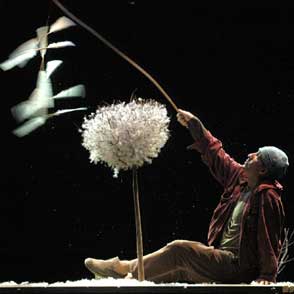
Claudio Casadio Tom Thumb offers children’s audiences the opportunity to come to terms with their fears. The story of Tom Thumb, in fact, is a “dark fable.” As Tom Thumb says to his older brothers, “How can you sleep? Perhaps it is because I’m afraid, but I can’t manage.”
The story’s hero may be tiny, but not even a big fear can stop him.
In fact, what gives Tom Thumb the power to triumph over life’s adversities is his curiosity and his wish to face reality bravely, even in its cruelest aspects. It is that curiosity that pushes him to be especially attentive to what his parents say and do, giving him the ability to prepare himself for danger and to act quickly when it arises.
A performer-narrator both describes the action and acts it out, involving the public in the performance—sometimes even directly. The narrative and the actor’s interactions with the children in the audience are often ironic, amusing, and comic, with touches of light-hearted dialogue enlivened by the rhythms of the Romagnolo dialect. |