| Andres Neumann International
presents
TANZTHEATER WUPPERTAL PINA BAUSCH
in
BAMBOO BLUES
A piece by Pina Bausch Director and Choreographer
Pina Bausch
Set Design and Videos Peter Pabst
Costume Design Marion Cito
Musical Collaboration Matthias Burkert, Andreas Eisenschneider Assistants to the Director
Robert Sturm, Daphnis Kokkinos, Marion Cito With
Pablo Aran Gimeno, Rainer Behr, Damiano Ottavio Bigi, Clémentine Deluy, Silvia Farias Heredia, Nayoung Kim, Eddie Martinez, Thusnelda Mercy, Cristiana Morganti, Jorge Puerta Armenta, Franko Schmidt, Shantala Shivalingappa, Fernando Suels Mendoza, Kenji Takagi, Anna Wehsarg, Tsai-Chin Yu Music
Trilok Gurtu & Arke String Quartett, Suphala, Sunil Ganguly, U. Srinivas & Michael Brook, Talvin Singh, James Asher and Sivamani, Bombay Dub Orchestra, Anoushka Shankar, Amon Tobin, Alice Coltrane, Bill Laswell, Talk Talk, Michael Gordon, Lisa Bassenge, Emmanuel Santarromana, Lutz Glandien, 4Hero, Jun Miyake, Solveig Sletahjell, Slowhill, Djivan Gasparyan A Co-Production with the
Goethe-Institutes in India
Speical thanks to our friends in India, and especially the Goethe-Institut Kolkata: Dr. Martin Wälde, S V Raman, Sucheta Hossain, Leela Chinoy, Mohammed Islam, Bina Sen, Misela Ternovsek, Madushree; Nandita Palchoudhuri, Patrick Ghose, Manish Chakrabarti, Achinto Bhadra, Dev Nayak, Sharmila Biswas, Prasanna Ramaswamy, Bickram Ghosh, Shuvaprasanna, Savitry Naïr, Sherry Padda; colleagues of Sanlaap, Sanved, Howrah Pilot Project; the Goethe-Institut New Delhi, Dr. Stefan Dreyer, Heiko Sievers, Mary Therese Kurkalang, Akshay Pathak; the National School of Drama, New Delhi: Amal Allana; Lufthansa Delhi: Werner Heesen.
Set Design Assistant Gerburg Stoffel
Costume Design Assistant Svea Kossak
Ballet Master Janet Panetta
Stage Manager Felicitas Willems
Technical Director Jörg Ramershoven
Lighting Director Fernando Jacon
Lighting Assistants Jo Verlei, Cordelia Mühlenbeck, Lars Priesack, Kerstin Hardt
Sound Karsten Fischer
Stage Technicians Dietrich Röder, Thies Müller
Properties Jan Szito
Wardrobe Ulrike Wüsten, Andreas Maier
Shiatsu Therapist Ludger Müller
BAMBOO BLUES
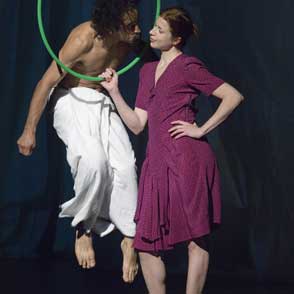
German choreographer Pina Bausch returns to Italy for the Italian premiere of Bamboo Blues at Spoleto’s Festival dei 2 Mondi. Bamboo Blues was created in 2007 in a co-production with the Goethe-Institutes in India, and comes to Italy following an international tour that included the Brooklyn Academy of Music and Paris’s Théâtre de la Ville, as well as theaters in Kolkata, Delhi, and Mumbai. Bausch’s prestigious Tanztheater Wuppertal company has not performed in Italy since 2007, and appears at Spoleto’s Festival dei 2 Mondi for the first time. Bausch’s performances at the Spoleto Festival will be her company’s only appearances in Italy during 2009. Bamboo Blues is inspired by Indian culture, but its kaleidoscope of colors, fabrics, foods, sounds, clothing, and much more are the source of its deep fascination. The performance was inspired by Bausch’s direct experiences during her frequent travels to India—from her first trip there in 1979 through to the 2006 tour that took her company to Kolkata and Kerala. Bamboo Blues is an exquisite container, an hypnotic mosaic of images that merges India’s both traditional and contemporary aspects. The rich symbolism, atmosphere, and cultural references of Bamboo Blues are transmitted via the delicate and powerful gestural language of Indian dance, the vibrant physicality of Bausch’s dancers, the set design with its bamboo scaffolding and white curtains that move in the breeze, the video projections, the brilliantly colored fabrics, the unmistakable aroma of cardamom. Bamboo Blues engages all the senses, at once magical in its evocation of the past and urgent in its aspirations for the future.
| Tanztheater Wuppertal Pina Bausch
Artistic Director: Pina Bausch / Managing Director: Cornelia Albrecht / Set Design: Peter Pabst / Costume Design: Marion Cito / Musical Collaboration: Matthias Burkert, Andreas Eisenschneider / Artistic Assistant to Pina Bausch: Robert Sturm / Rehearsal Assistance: Josephine Ann Endicott, Bénédicte Billiet, Matthias Burkert, Marion Cito, Barbara Kaufmann, Daphnis Kokkinos, Ed Kortlandt, Dominique Mercy, Helena Pikon, Hans Pop / Ballet Masters: Christine Biedermann, Ernesta Corvino, Ed Kortlandt, Paul Melis, Agnes Pallai, Janet Panetta, Antony Rizzi / Pianist: Matthias Burkert / Collaboration photo/video (as guests): Ulli Weiss /Photo; Jérôme Cassou /Video; Stage Manager: Peter Lütke, Felicitas Willems / Personal Assistant to Pina Bausch: Sabine Hesseling / Assistant to Pina Bausch: Marc Wagenbach / Assistant to Managing Director: Katharina Bauer / Organisation: Katharina Bauer, Grigori Chakhov, Claudia Irman, Ursula Popp / Video Archives: Grigori Chakhov / Press and Publique Relations: Ursula Popp / Technical Director: Manfred Marczewski, Jörg Ramershoven / Lighting Director: Fernando Jacon / Lighting Assistants: Jo Verlei, Kerstin Hardt (as guest) / Stage Technicians: Dietrich Röder, Martin Winterscheidt / Sound: Andreas Eisenscheider, Karsten Fischer / Properties and Merchandising: Jan Szito / Wardrobe: Harald Boll, Silvia Franco, Andreas Maier, Katrin Moos, Ulrike Wüsten / Shiatsu Therapist: Ludger Müller. Andres Neumann International
Producer: Andres Neumann
Production Manager: Elena Di Stefano
Technical Supervision: Massimo Monachesi
Press: Marina Baldeschi Assistance in Spoleto: Linda Di Pietro Pina Bausch
was born in Solingen, Germany, in 1940. In 1955, she began to study dance at the Folkwang Hochschule in Essen under the direction of Kurt Jooss, where she received her diploma in 1958. A scholarship allowed her to continue her studies in the United States at the Juilliard School of Music in New York. She performed with the Paul Sanasardo-Donya Feuer Dance Company, with the New American Ballet, and at New York’s Metropolitan Opera. She returned to Germany in 1962 and joined the Folkwang-Ballett. Beginning in 1968, Bausch’s choreography began to be added to the Folkwang-Ballett’s repertory and, the following year, she became the company’s artistic director. In 1973, Bausch founded the Tanztheater Wuppertal, considered the world’s most important theater-dance company, where she currently serves as director and choreographer. The Tanztheater Wuppertal has produced a large number of new works and has also engaged in collaborations with international companies such as the Opéra Nationale de Paris where Bausch created the choreography for The Rite of Spring in 1977 and for Orpheus and Eurydice in 2005.
In addition to her work as a choreographer, Bausch also appeared in Federico Fellini’s 1982 film, And the Ship Sails On and, in 1990, she directed the film Die Klage der Kaiserin (The Complaint of an Empress). In 1998, Bausch directed Béla Bartók’s opera Herzog Blaubarts Burg (Duke Bluebeard´s Castle) for the Festival International d’Art Lyrique in Aix-en-Provence, under the musical direction of Pierre Boulez. In 2001, she collaborated in Pedro Almodóvar’s film, Talk to Her, with scenes drawn from her productions Café Müller and Masurca Fogo.
In 1998, Bausch hosted Ein Fest in Wuppertal together with friends and artists from around the world, a celebration of the Tanztheater Wuppertal’s 25th anniversary. Bausch revived the Ein Fest program in 2001 as an annual event, and the most recent edition was held in November 2008 in Dusseldorf, Essen, and Wuppertal.
Bausch has received numerous prizes and honors for her work and for her productions with the Tanztheater Wuppertal. She has, among other honors, won the Premio Ubu three times (in 1983 for best foreign performance, in 1990, and in 1997) and, in 1999, was awarded the Premio Europa for theatre as well as an honorary degree in performing arts from the University of Bologna. In 2003, in Paris, she was named a Knight of the National Order of the Legion of Honor and, in 2006, she was presented with the Laurence Olivier Award in London and named honorary director of Rome’s National Academy of Dance.
In 2007, Bausch was awarded a Golden Lion prize at the Venice Biennale for lifetime achievement and, in that same years, also received the Kyoto Prize in Japan in the “Arts and Philosophy” category.
In 2009 she once again received the Laurence Olivier Award for her productions of Café Müller and The Rite of Spring.
Peter Pabst
Born in 1944, Pabst studied Costume and Scenic Design at the Werkschulen in Cologne, Germany, from 1969 to 1973.
He was hired by the Schauspielhaus Bochum in 1973 and remained there until 1979, where he worked primarily with directors Peter Zadek and Augusto Fernandes. Among his duties, he designed costumes for Zadek’s productions of Professor Unrat and Hedda Gabler, and sets and costumes for Othello at the Deutsches Schauspielhaus in Hamburg and for Spring Awakening and Hamlet at the Schauspielhaus Bochum. For Fernandes, Pabst designed the costumes for Federico García Lorca’s Doña Rosita the Spinster and Pedro Calderón de la Barca’s The Great Zenobia, as well as sets and costumes for Lorca’s The House of Bernarda Alba.
Since 1979, Pabst has worked as a set and costumer designer for important theater, opera, television, and film productions.
He began his collaboration with Bausch in 1980 and, since then, has designed the sets for all of the Tanztheater Wuppertal’s productions.
Marion Cito
Born in Berlin, Cito studied dance with Tatjana Gsovsky, and made her first professional appearance with the Deutsche Oper Berlin in 1954. Since 1960 she has danced as a prima ballerina for Tatjana Gsovsky, George Balanchine, Kenneth McMillan, Serge Lifar, John Cranko, and Antony Tudor. In 1972, she joined Gerhard Bohner’s company in Darmstadt.
She entered the Pina Bausch company in 1975, first as a dancer and choreographic assistant. Since 1980, she has worked as a costume designer.
|