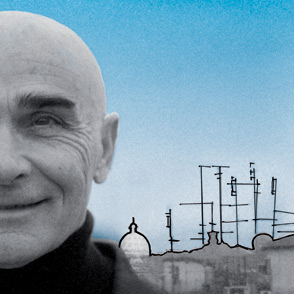
| world premiere by Luigi Malerba
adapted and directed by Gianluca Bottoni
readings Franco Mazzi
sound Hubert Westkemper
set design and costumes G. B. Studio
production G. B. Studio poster by Desislava V. Stoichkova
"The city kept moving around me as if I didn´t exist..." A grey misanthrope is wandering through the streets of Rome.
It is the same tricky Rome of years ago, made of sunsets and monuments, made of busy bodies, workmen, traders, timewasters, all turning around themselves.
At the margin of this smooth buzzing there is a mythomaniac man who doesn´t manage to be in touch with this metropolitan “non-reality”. He can only take small, abnormal, misshapen actions dictated by his obsession. He can only pilot them according to his sensations, to the impertinent pulses he receives, almost always in an acustic way, from that noisy external bubble to his microcosm.
And in this resonant world, there is a place for everything, either for “talking places” and for “comedie humaine´s” characters; there is a place even for a fiancée who will be murdered. After a police investigation, there will be even place for a final(?) worthy of a true detective story.
Who is the guilty?
Guilty of what? Of the (non) behaviour of the protagonist? Of the (non) behaviour of the other people? Of the hardly visible drift of a society starting to be dissonant? Of a deal attitude to …the thruth? Which thruth? Spot... | Nice lies or can a stamp trader fly? In this very peculiar anti-novel by Malerba, the main character who, since he was a child observed instead of participating, looked at instead of being, as the other children, discloses to us that, at present, he is obliged to follow imagination only, as a value of the nothing happening to him.
I have immediately felt in him a likeable analogy with those living of sensible arts such as the theatre, that are moving themselves in alternative worlds, with figures and sounds which are often invented, replacing those that for the others are the ordinary social relationships.
The first idea was that of telling this old-fashioned setting story for its being across the passage from an age (the story is dated 1966 but I like to imagine it scenically some year after) which is that of the petty bourgeois period of adjustment of the post-war Italy and the age of complete drift of the “must” that were to represent the confidence of this Italy.
The idea from which to start could only be the radio, we thought of an original in episodes for the radio: which other medium could better fit a vintage audio story?
Television, small cinemas, handicraft shops, districts which are still human, petty bourgeois routine with snake eggs ready to disclose by destructuring, antennas, roofs, churches and their domes.
More, travels to the sea or to see airplanes taking off, with their poetic power of suggestion; the “dream” had its reasons, as the neon lights and the Tiber in-flood, and car traffic made of Lancia and Fiat Seicento Multipla.
As Neo-realism wasn’t there anymore, as well as the purity of the “ragazzi di vita”, and the Country was crossed by several currents and accidents, it was beginning to cultivate a new “lie”. In this climate, the storm was preparing in which I would have grown, and the sound of the tale is also that of my childhood, besides that of the main character. The post-modern was arriving and would have passed, the speech was beginning to wrap on its own, those sounds began to multiply and become hue and cry.
And so, in this background, the compulsive liar mind of “The Snake”, probably already wounded by the bombings happened in his childhood (underground… bombs exploded above our heads), retires himself and works on himself: it’s him (or the author) to direct as a radar, he takes sounds from the ordinary and makes them the score of a world of his own, (you must be gifted to invent such scenes), with his own characters, where from time to time the belief appears that one day he, a stamp trader, will take off.
In Malerba’s text there are really many “aural” metaphors, so that it is a continuous feeling recorder (all the world is a species of resonating chamber where natural concerts sound). However, the fact of making the worlds on one own, for oneself, it’s a game that could be lost hold of, and rise suspects.
With Hubert Westkepmer, we wished to create a sound score that would disseminate the path of suspicious notes and, eventually we pandered to the main character that “obsessively” hears those sounds seeming to follow him and that are of several kinds, from natural to supernatural (…certain things seem to be invented on purpose, they are there and speak, you only need to make them speak…).
This story is told us by an actor. A theatre actor. “By keeping to talk to tell they will think… I’m a visionary”.
Franco Mazzi, with his Joycean background, standing still in front of a microphone, reads the words corresponding to the thoughts of the story main character, who is trying to convince us (by his thoughts?) that he’s not standing still, but that he is going around like a misanthrope flaneur, and we follow him and pander to him in his hearing and reporting also the other characters’ voices. Also the dreams, also the shadows, by utilising all the possibilities that Malerba’s almost “open” work offers to us.
Perhaps, right here in this multiplicity of sounds and evocations there is the thriller solution, of the mystery that from a certain moment becomes clearly visible with a crime.
In a fake world, sooner or later there is an extreme action, even very bloody. Is it not what is happening today in the reality? Advertising?! P.S.: Talking about advertising… Two words on the intervals that create code contrasts by the use of a particular vocabulary, debunking and popular at the same time: these are our commercials, the dedication to the one who was also author of TV ads from the 50’s to the 70’s, when they were written by even important authors who needed money to survive.
Gianluca Bottoni
|