| A young woman faces a fundamental choice for her life: whether or not to remain in the place of meditation and prayer where she finds herself. She asks her teacher and guide a series of questions focused on two topics. The first is the end of Jesus, namely the historical reasons (leaving the Scriptures out of consideration) why, on that famous spring day in Jerusalem, his death sentence was passed and carried out.
The second topic, which derives almost directly from the first is, how the church, said to be his and inspired by him, corresponds to his message with its realistic behaviour. If the continuous interference in state affairs corresponds or not to the message of the gospel. Hadn’t Jesus separated ´God´ from ´Caesar´?
During the dialogue, confidential tones, almost tinged with tenderness, alternate with others where the contrast is sharp, almost torn to violence and the words could strike like stones.
The young woman is clearly baffled by the environment, by what she has seen and heard in that place. While the two are talking, the teacher receives some telephone calls. At the other end someone is asking him to do something and the teacher refuses. The phone calls become pressing but the refusal remains. Then someone calls again and the teacher speaks using the title ´Excellency´. The answer changes, it becomes a yes. So it goes, he will do something which his conscience had rebelled against until that moment.
The grand dialogue that follows is bitter, it talks about doing and being, caring too much about the world, getting lost in the play of material interests and power, no longer being able to reconcile the stimulus of ideals and the weight of responsibility.
As a consequence, other things are also discussed: the distance, the contrast, between the figure of Jesus, unarmed prophet, friend of the humble, of children, of women, and the Christ of faith that triumphs in the gold of the mosaics, in the glory of the liturgy, in the magnificence of power, the triumphant king covered by the cloak of theology.
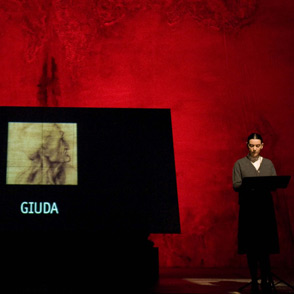
The dialogue between the two characters in the scene is alternated with several presences emerging from the time of Jesus, from his Israel. They appear and then vanish into thin air, witnesses of his actions, the protagonists of the process: an Essene (sect which Jesus himself probably belonged to); Nicodemus’ secretary, one of the few Pharisees who sided with Him; the Procurator Pontius Pilate; Judas who in a heartfelt confession will reveal the reasons for his ‘betrayal’; the woman who Jesus saved from lapidation, reveals the reasons why she committed adultery; Magdalene states her sacred love for the Savior.
The final will not answer all our questions. We will not know for sure whether the young woman will stay or not, everyone will find the possible answer within one’s self.
But we will have rebuilt a reasonable ´historical´ explanation for the conviction of a man who was changing the world.
| by Corrado Augias
mise en espace Andrea Liberovici
with
Paolo Bonacelli and Stefania Pascali
with the video participation of
Don Andrea Gallo, Eyal Lerner, Mario Menini, Moni Ovadia, Gianna Schelotto, Michele Serrano
lighting design Sandro Sussi
production Promo Music - Teatro Stabile di Genova |