| |
 |
|
|
 |
|
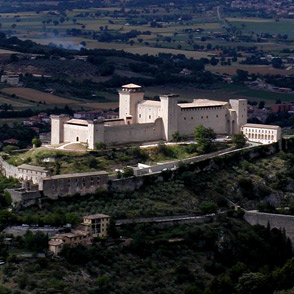
Fortress (Rocca) - Festival Venue
On Sant’Elia’s hill, dominating the town at an altitude of 453 mt. (1486 feet), in the 5th century there was an Acropolis, a worship centre that was cancelled during the Medieval age and grew once again in 1359 with the erection of the Fortress, wanted by Cardinal Albornoz to re-establish the papal power during the post-Avignon period. Home to the papal governors, among other major personalities it hosted Julius II and Lucrezia Borgia, governess of the Dukedom from 1499 to 1501. After 1817 it became a prison, active until 1983.
After a long restoration, today it hosts the Dukedom National Museum (Museo Nazionale del Ducato) with works dated 4th-15th century, a large hall and an outdoor theater seating up to 1,200.
It is also venue of the European School for Book Restoration and a Diagnostic Restoration Lab of the Arts and Culture Ministry. A park, a restaurant, guestrooms, and shops complete the complex structure. |
|
|
 |
|
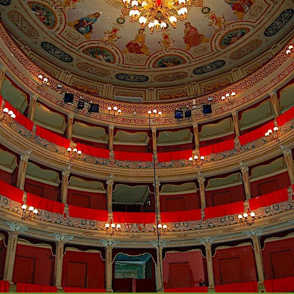
Caio Melisso Theater Spazio Carla Fendi - Festival Venue
Located in the Duomo Square, it was built in 1664 as the “Noble Theater” to confirm the ancient passion of the people of Spoleto for this art. Restored in 1880 by Giovanni Montiroli, presently the venue sits 300 people. |
|
|
 |
|
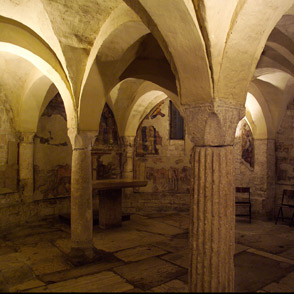
Sant’Ansano
Built during the Romanic age and restored in 1700, it preserves a 1500 cloister and, underground, a temple of the Augustan age. The crypt dated 12th century and dedicated to St. Isaac is remarkable, presenting interesting parts of frescoes and Romanic capitals. |
|
|
 |
|
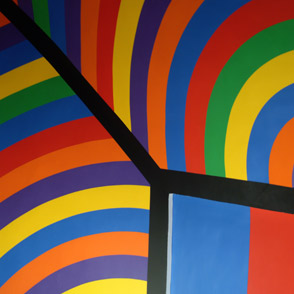
Gallery of Modern Art (Galleria Comunale d’Arte Moderna)
In Vicolo III behind Piazza della Libertà. Visiting hours: 10am-1pm and 3pm-6pm, closed on Mondays. Besides others, it hosts works by Consagra, Burri, Sol Le Witt, Pomodoro, Turcato, Vespignani. |
|
|
 |
|
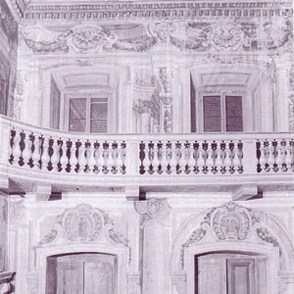
Palazzo Leti Sansi - Festival Venue
This Neoclassical building was constructed at the beginning of the 17th century and is enriched by a stone portal elegantly decorated. In the 90s it was accurately restored and destined to culture and exhibitions. |

|
|
|
|
|




;void(null);)
;void(null);)
;void(null);)
;void(null);)
;void(null);)